


AI can size a market. It can't tell you which one to enter first.
By Sneh Mehta, Growth Consultant at Think & Grow · 5-minute read
The short answer: AI can't choose your next market on its own. AI research tools are fast and useful for groundwork: listing competitors, gathering sources and summarising the regulations. But a market-entry decision needs market sizes that agree with each other, data you can trace, and judgement on price, time to sell and partners. That still takes experienced people.
We tested this. I gave an AI research tool the same market-entry brief our team had just delivered for a client. It came back with confident numbers, three sections without a single source, and a recommendation to enter the market the client already sold in and wanted to expand out of.
Here's what happened, and when you should (and shouldn't) use AI for market entry.
What happened when we gave AI a real market-entry brief?
The client makes body-worn cameras and evidence software for police forces. In the US, 2 incumbents hold most of the contracts, so the CEO asked us a simple question: which market should we go to next?
After we'd delivered our recommendation, I ran the same brief through an AI research tool that used 6 agents. Here's what came back.
Where the AI report fell short
- Incomplete: 1 of its 6 agents returned no data at all.
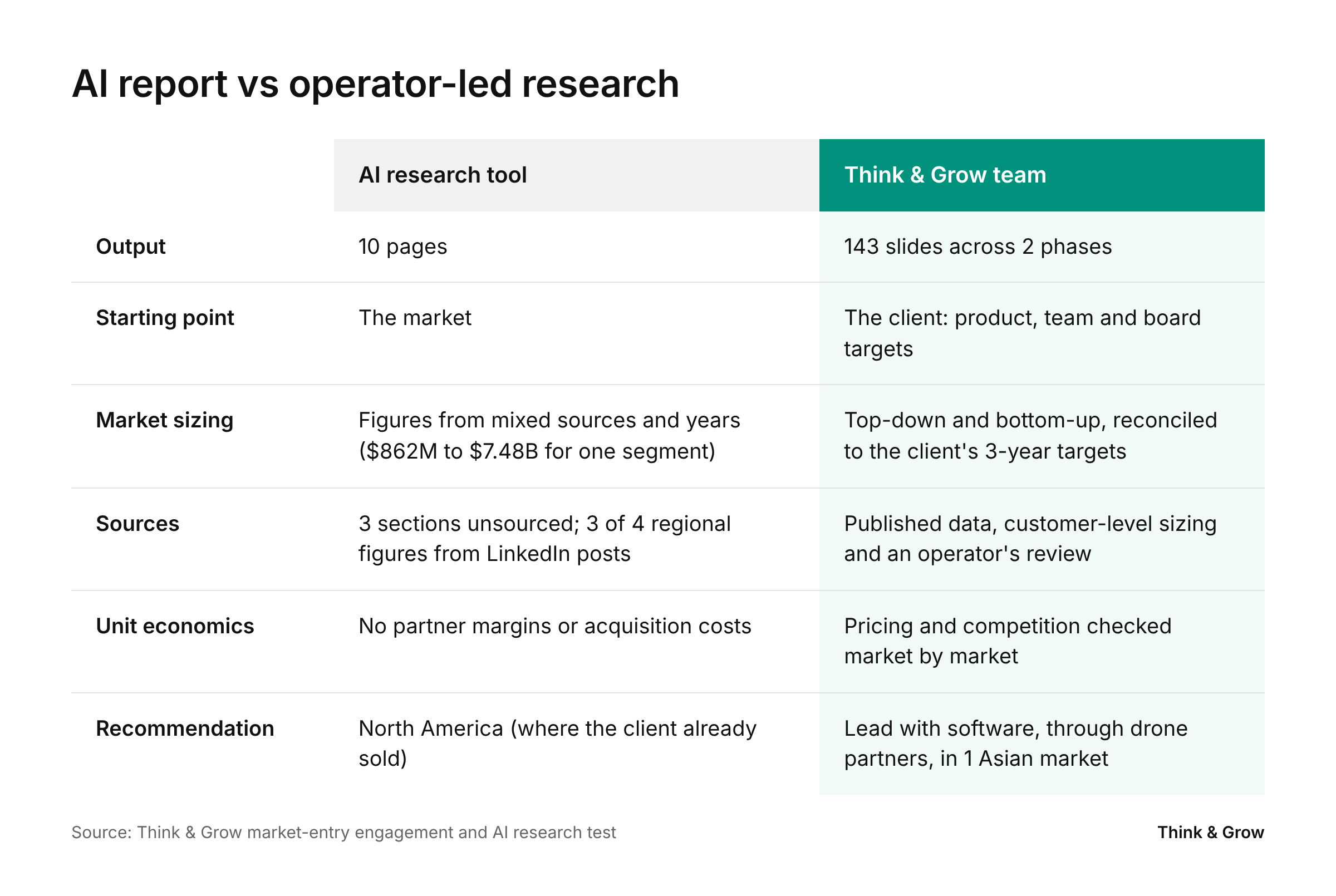
- Unreliable: 3 sections cited no sources: competition, buyer behaviour and financials.
- Inconclusive: its market size for the same segment ranged from $862M to $7.48B, pulled from different sources and different years. That's nearly 9 times apart.
- Untrustworthy: 3 of its 4 regional figures came from LinkedIn posts.
- Misleading: it found no data on partner margins or customer acquisition costs, so the economics of entry were missing.
- Redundant: it recommended North America first, the market the client was trying to expand out of.
Where it did well
To be fair, the agents did some of the generic groundwork fast. In a day, they listed the competitors and the regulations that apply. That's useful. It just isn't a decision.
An expansion decision worth millions needs numbers that agree with each other, built on data that's complete and reliable.
Why can't AI choose a market for you?
The test showed 3 gaps that matter for any expansion decision:
- It doesn't know your company. The AI started with the market. A good recommendation starts with your product, your pricing and the targets your board has set.
- It can't reconcile conflicting data. When sources disagree by a factor of 9, someone has to decide which number to trust and why. The AI simply reported both.
- It has no judgement. An AI report is a static snapshot. It can't tell you that your price rules out a market, or that regulatory sign-off will delay your first sale by most of a year.
How should you build a market-entry recommendation?
Here's the sequence we followed for this client. It's the part the AI skipped.
- Start with the company, not the market. We spent the first 2 weeks on the client: a product demo, time with the head of product, and the revenue targets the board had set.
- Size each market both ways. Top-down from published data, and bottom-up from the customers the client could realistically win. We kept going until the numbers matched the client's 3-year targets.
- Check price fit. The client's camera sat at the top of the market, which ruled out countries that buy on cost.
- Work out the time to first sale. In the strongest candidate market, the camera needed about 9 months of product work and 9 months of regulatory sign-off before a single sale.
- Test your thinking with an operator who's been there. A US operator who'd worked at a camera manufacturer pressure-tested our view on partners and procurement.
- Sequence the entry. The plan became: lead with software, through drone partners, in 1 Asian market. Sell the software now while the camera works through sign-off. Software leads, drones open the door, hardware follows.
That sequence, and the logic behind it, is what makes a recommendation defensible in front of a board.
What should you use AI for in market research?
Use AI where speed matters more than judgement. Keep people on the decisions.

Key takeaways
- AI is good at fast groundwork: sources, competitor lists and regulatory primers.
- In our test, AI market sizes for one segment ranged from $862M to $7.48B, and 3 sections had no sources.
- The AI recommended the market the client was already trying to expand out of.
- A defensible market-entry recommendation starts with the company, sizes markets top-down and bottom-up, and checks price, time to sell and partners.
- The output you need is a sequence, not a snapshot: what to sell, through whom, where and in what order.
Frequently asked questions
Can AI do market-entry research?
AI can do part of it. It's useful for collecting sources, building a first competitor list and summarising regulations. In our test it couldn't produce consistent market sizes, sourced financials or a sensible recommendation, so it shouldn't be the basis for an expansion decision.
How accurate is AI market sizing?
In our test, not accurate enough to act on. The AI's market size for a single segment ranged from $862M to $7.48B because it mixed sources and years, and 3 of its 4 regional figures came from LinkedIn posts.
What's the difference between top-down and bottom-up market sizing?
Top-down sizing starts from published market data and narrows it to your segment. Bottom-up sizing starts from the customers you could realistically win and what they'd pay. Using both, and reconciling them, gives you a number you can defend.
What should a market-entry report include?
At a minimum: market sizes built top-down and bottom-up, your price position against local buyers, competition, partner and procurement routes, the time to first sale (including product and regulatory work), and a clear sequence for entry.
Should a CEO trust an AI report for an expansion decision?
Use it as a starting point, not a recommendation. Check every figure has a source, that the numbers agree with each other, and that the recommendation reflects your product, pricing and targets.
About the author
Sneh Mehta is a Growth Consultant at Think & Grow. She has led Market Intelligence work for Safe Software, Snowflake and VTS.