




Executive search or operator-led advisory: who should hire your leaders?
By Simon Robinson, Growth Partner, Think & Grow · 2/11/2026 · Last updated 3/11/2026
In short: use a traditional executive search firm when the role is clear and you have no growth phase ahead of you. Use an operator-led growth partner when you’re not yet sure the role is right, or when the hire is tied to a bigger move such as a new market, a raise or a restructure. In that case, the brief matters as much as the search.
This guide is for CEOs and founders of 50–300 person tech scale-ups in Australia, the UK and the US deciding who should run their next senior hire.
Why can senior hires miss the mark in scale-ups?
Most senior hires in scale-ups aren’t bad candidates by any means. They’re good humans in a role that was unfortunately scoped for the wrong stage. For example:
- A CTO hired when the business needed a VP of Engineering – someone to lead delivery and a growing team – not set technology strategy.
- A CRO hired into a sales team with no agreed roles or shared metrics, who spends their first quarter on discovery.
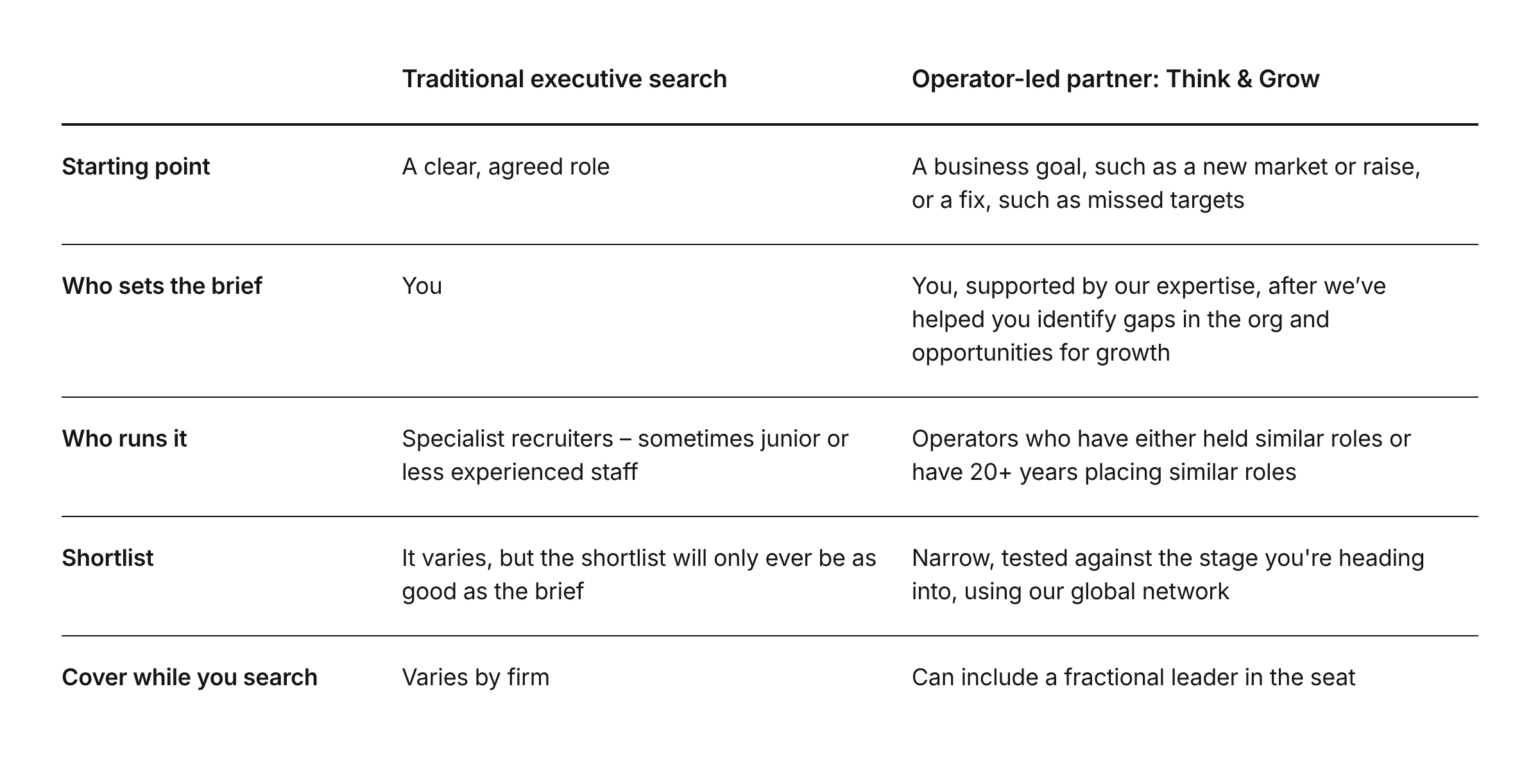
So, here’s the real difference: a search firm will usually work to the brief you give it, whereas an operator-led partner should test the brief first because they know it might need to be reworked or even ripped up.
Executive search firm vs operator-led partner: what's the difference?
A traditional search firm finds candidates for a role you have already defined. An operator-led partner starts one step earlier, checking the role against your stage and plans before the search begins.
When should you use a traditional executive search firm?
A traditional search firm can be the right call when:
- the role is clearly defined and agreed by the leadership team
- the structure around the role is settled
- you're replacing a leader in a role that already works
When is an operator-led partner a better fit?
When the role itself is still a question, or the hire is part of a bigger change:
- you're not sure the role is right for your next stage
- the hire is tied to a new market, a raise or a restructure
- it's the first leader in a new function or country
- your leadership team doesn't yet agree on what the role should own
- you need someone covering the role while the search runs
- growth has stalled and you’re not sure why
What does operator-led search look like in practice?
At Think & Grow, the search starts with a deep dive into your business; the goals, current team capabilities, and challenges. That’s how Prospa were able to hire the leaders for their next growth phase:
Prospa's product and technology function needed a vision that aligned to their next growth phase. Experienced leadership roles were required to help create and develop a strategy and execute against it.
- We worked with both founders to assess current product and technology capability before running an executive search across ANZ.
- Identified the gaps in fintech skills and experience regarding deep understanding of customer problems in the B2B lending space.
- Hired a Chief Product & Technology Officer with deep knowledge of the fintech space and experience scaling one of Australia's biggest fintechs.
- Hired a VP Engineering to lead and grow the engineering team required.
“We trust Think & Grow – their network as well as their understanding of our business is super strong. They had the right person before I’d even met them! I’d recommend them to any business.” - Andrew Malak, CPTO at Prospa
What should you ask an executive search partner?
Ask how they’ll test the role, not just how they’ll fill it. Four questions to put to any firm:
- Who on your team has held or filled this role at a company our size?
- How will you test the brief before you start the search?
- How do you know the brief reflects what our company needs?
- What happens if the hire isn't working after six months?
How Think & Grow helps
Think & Grow has filled 1,000+ roles for tech scale-ups across Australia, the UK and the US. Our executive search is run by operators who have held or filled these roles ten times over, backed by capability reviews, org design and fractional leaders when you need cover while the search runs.
Talk to Think & Grow about your next leadership hire
Frequently asked questions
What is operator-led executive search?
Search run or shaped by people who have held the role themselves. They test whether the role fits your stage and plans before going to market, then search against that brief.
What's the difference between retained and contingent search?
With retained search, you engage one firm exclusively and pay in stages as the search runs. With contingent search, you pay only when a candidate is hired, and several firms may work the role at once. Senior and confidential roles usually go to retained search.
How long does an executive search take for a scale-up?
It depends on the role, the market and how settled the brief is. Agreeing the brief before the search starts is usually the quickest way to shorten it. [Add a typical range only from placement data.]
Should we hire through our network or use a search firm?
Use your network when you already know someone who fits the role at your next stage. Use a search partner when you need a wider view, a confidential process, or a role your network hasn't filled before.